If you have been researching an IPTV service in 2026, you have probably hit the same wall most US consumers hit: a confusing mix of licensed streaming apps, overseas resellers, Reddit threads full of acronyms, and a nagging question about whether any of this is actually legal to use.
This guide answers that question first, then walks through what an IPTV service really is, how to evaluate one honestly, and which licensed options are worth your time in 2026. No hype, no fabricated numbers, no copyright-infringing shortcuts.
Is IPTV Legal in the USA?
Short answer: Using a licensed IPTV service in the United States is legal. Paying for or operating an unlicensed service that redistributes copyrighted channels without permission is not. The 2020 Protecting Lawful Streaming Act (PLSA) made large-scale unlicensed streaming a federal felony — but the law targets operators and large commercial infringers, not ordinary subscribers.
That is the 40-word version. Here is the nuance.
The PLSA, signed into law in December 2020, upgraded commercial illicit streaming from a misdemeanor to a felony punishable by up to ten years in federal prison. According to the Copyright Alliance, the statute is deliberately scoped to “digital transmission services” that willfully offer infringing content for commercial advantage — in plain English, the people running the server, not the person watching at home.
That gives you a three-tier framework when you compare any IPTV service:
- Legal. Licensed virtual multichannel providers (vMVPDs) like YouTube TV, Hulu + Live TV, Sling TV, fubo, DirecTV Stream, and Philo. They pay carriage fees to networks. You are a normal paying customer.
- Grey area. Overseas resellers that bundle hundreds of channels for a flat annual fee without naming a licensing body. Enforcement against end users is extremely rare, but you have no consumer protection if the service disappears.
- Illegal. Operating, hosting, or reselling an unlicensed stream commercially. This is what PLSA was written for.
This article covers the licensed tier and one subscription-only service that publishes its licensing details transparently. We do not recommend, review, or link to pirate services.
What Is an IPTV Service?
IPTV stands for Internet Protocol Television. Instead of receiving TV channels through a coaxial cable or a satellite dish, an IPTV service delivers them to you as data packets over your home internet connection — the same pipe that carries your email and your streaming apps.
The important thing to understand is that “IPTV” is a delivery technology, not a legal status. YouTube TV is an IPTV service. So is Sling. So are the overseas reseller apps that get most of the attention on forums. What separates them is who owns the rights to the content they transmit.
Cable vs SVOD vs IPTV
| Traditional Cable | SVOD (Subscription Video On Demand: Netflix, Disney+) | IPTV | |
|---|---|---|---|
| Delivery | Coax / satellite | Internet (on-demand) | Internet (live + on-demand) |
| Content model | Live channels | On-demand library | Live channels + VOD |
| Hardware | Set-top box + contract | App on any device | App on any device |
| Typical commitment | 12-24 month contract | Month-to-month | Month-to-month or annual |
| Live TV included | Yes | No | Yes |
Key components of any IPTV service
- EPG (Electronic Program Guide) — the on-screen grid that shows what is on each channel, now and later. A good EPG goes 7 days forward and is accurate to the minute.
- VOD (Video On Demand) — a library of movies and shows you can watch any time, separate from the live channels.
- Catch-up TV — the ability to rewind a live channel to see something that already aired. Usually offered as a 24, 72, or 7-day window.
- M3U — a plain-text playlist format that tells a player app where each channel’s stream lives. Most licensed services do not expose M3U links; most unlicensed ones do.
- Player app — the software you actually watch inside. Can be the service’s own branded app, or a third-party player like TiviMate or IPTV Smarters.
How to Choose an IPTV Service: 7 Criteria
Most buying guides for an IPTV service rank by channel count. That is the wrong starting point. Here is a better one.
1. Licensing transparency
Does the provider say, on the record, which networks or distributors it is licensed to carry? Licensed vMVPDs publish their channel-pack contents and update them when carriage deals change. Overseas resellers almost never do. If a service lists “20,000+ channels” with no licensing statement, that is your signal.
2. Trial availability
A trial that lets you watch for real — not a 10-minute demo and not a payment-wall preview — tells you more than any review will. Any service confident in its product offers one. Length varies wildly (24 hours to 21 days) and matters less than whether the trial exists at all.
3. Pricing model: annual vs the monthly trap
Monthly pricing looks cheaper on the signup page and quietly becomes the most expensive option over 12 months. Licensed vMVPDs are almost all monthly. A few niche services, including the one we feature in the mid-article card below, publish annual pricing instead. Compare like with like: multiply any monthly figure by 12 before you compare it to an annual quote.
4. Channel breadth and relevance
A 10,000-channel service with no channels you actually watch is a worse deal than a 60-channel service that has your five must-haves. Make a list of channels you watched in the last 30 days before you shop. If a service does not carry them, the price is irrelevant.
5. 4K and HEVC support
4K streaming delivers roughly four times the pixels of 1080p HD. HEVC (High Efficiency Video Coding, also called H.265) is the compression standard that makes 4K streaming practical over a typical US home connection — it is roughly twice as efficient as the older H.264 standard. If a service advertises 4K but your player app does not support HEVC decoding, you will not actually get 4K.
6. Device compatibility
The free-but-painful default is a browser on a laptop. The useful configurations are: Amazon Fire TV Stick, Android TV box, Apple TV / iOS, a Smart TV with a native app, or a dedicated Mag box. Check that your preferred device is on the compatibility list before you pay.
7. Support quality
A real support channel (ticket system or live chat, not just an email that bounces) separates services you can rely on from services you cannot. Test it during the trial by asking a technical question and timing the response.
Ready to Experience Premium IPTV?
Echo Best IPTV annual plans start at just €29.90/year. All plans include 4K content and a 24-hour trial.
Best IPTV Services for US Viewers in 2026
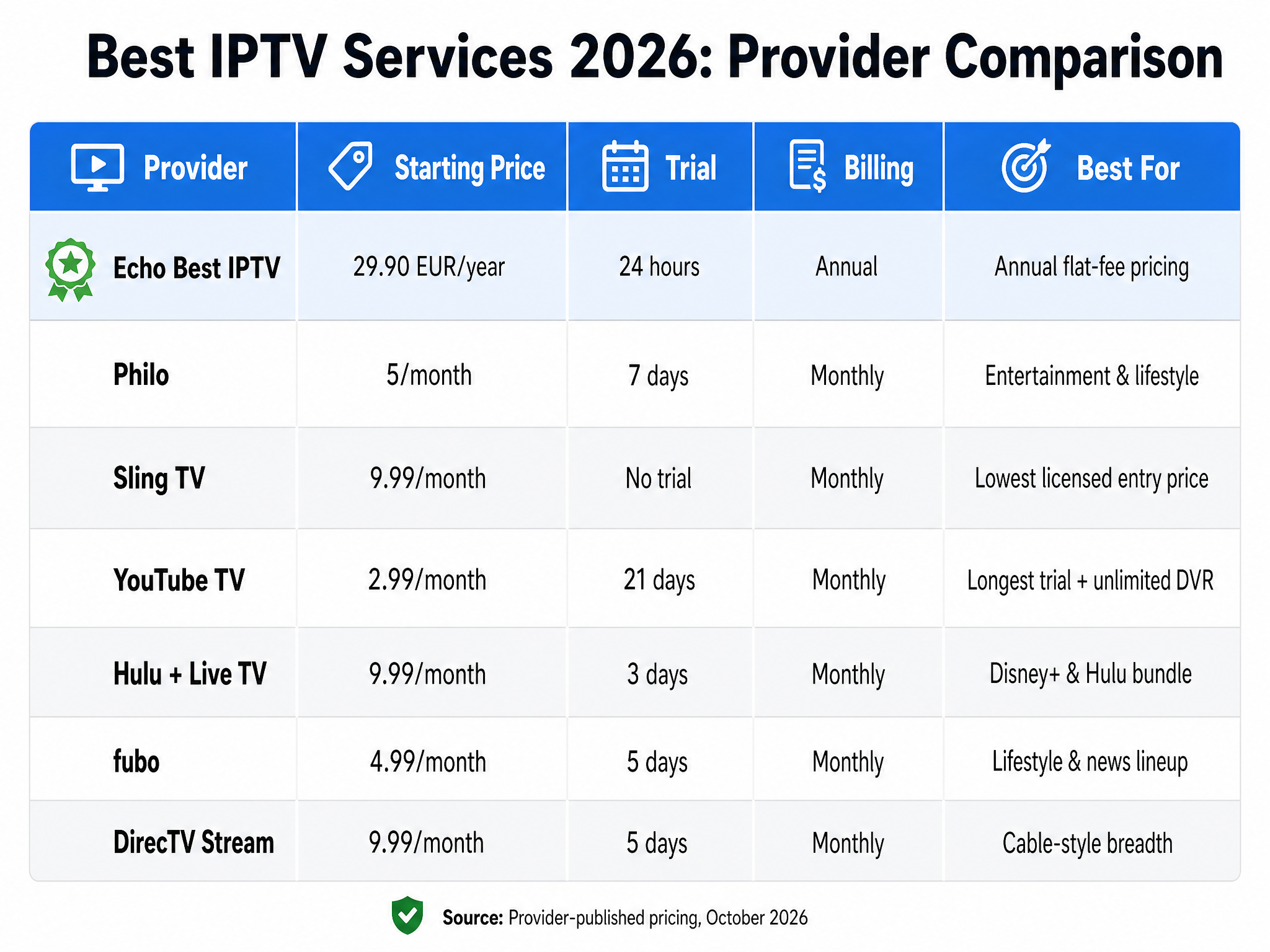
The table below compares the six main US-licensed vMVPDs plus Echo Best. Pricing for the vMVPDs is drawn from TROYPOINT’s September 2026 streaming price roundup; Echo Best figures come from the provider’s published annual plan structure. We have deliberately excluded any mention of specific sports channels, teams, or leagues from this guide.
| Service | Starting Price | Trial | Billing | Best for |
|---|---|---|---|---|
| Echo Best IPTV | €29.90/year | 24 hours | Annual | Users who want annual, flat-fee pricing |
| Philo | $25/month | 7 days | Monthly | Entertainment-only lineup, no live news |
| Sling TV | $19.99/month | None | Monthly | Lowest licensed vMVPD entry price |
| YouTube TV | $82.99/month | 21 days (varies) | Monthly | Longest trial, DVR included |
| Hulu + Live TV | $89.99/month | 3 days | Monthly | Bundled Disney+ / Hulu library |
| fubo | $64.99/month | 5 days | Monthly | Lifestyle & news-heavy lineup |
| DirecTV Stream | $89.99/month | 5 days | Monthly | Cable-style channel breadth |
Echo Best IPTV — €29.90-€69.90/year
Echo Best publishes four annual plans and does not offer a monthly rolling option. The entry Economy plan is €29.90/year; the top Ultimate plan is €69.90/year. All plans include a 24-hour trial — enough time to run a real-world test on your own hardware before you commit. The higher tiers add catch-up TV and 4K/HEVC playback. Device compatibility covers Fire TV Stick, Android TV, iOS, Smart TV, and Mag box, which is wider than most licensed vMVPDs.
Who it is for: viewers who want a single transparent annual charge and a technology-forward feature set, and who have confirmed during the trial that the channels they actually watch are present.
Philo — $25/month
Philo takes the opposite approach: a deliberately slim entertainment-heavy lineup of around 70 channels for a flat $25/month. There are no local broadcast affiliates, no sports networks, and no live news in the base package. A 7-day trial is available. If your TV diet is scripted shows, lifestyle, and documentaries, Philo is the cheapest licensed vMVPD you can realistically live with.
Sling TV — $19.99-$60.99/month
Sling has the lowest sticker price on the licensed side at $19.99/month for its single-service tier, but there is no free trial — you commit before you watch. Two tiers (Sling Orange and Sling Blue) carry different channel groups; a combined tier runs higher. Add-on packs let you tune the lineup, which is useful but easy to overspend on.
Hulu + Live TV — $89.99/month
Hulu + Live TV bundles the full Hulu on-demand library and Disney+ with its live channel lineup, which is why its headline price sits above most peers. A 3-day trial is available but short — plan to use every hour of it. Good fit if you were going to pay for Hulu and Disney+ separately anyway.
YouTube TV — $82.99/month
YouTube TV has the longest trial window of the US vMVPDs (promotional length varies, often up to 21 days) and includes unlimited cloud DVR with a long retention window. Family sharing works across up to six accounts. The weakness is price inflation — the base rate has risen multiple times since launch.
fubo — $64.99-$98.99/month
fubo originally positioned around sports but has broadened into a general entertainment and news vMVPD; we are deliberately not detailing specific channel categories here. The 5-day trial is enough for a real evaluation. 4K streaming is available on upper tiers.
DirecTV Stream — $89.99-$169.99/month
DirecTV Stream is the closest a vMVPD gets to a traditional cable channel lineup, which is reflected in both channel count and price. A 5-day trial is offered. The top tier crosses $150/month and is really only sensible if you are replacing a specific legacy cable package feature-for-feature.
Annual vs Monthly Pricing: The Math That Actually Matters
Monthly pricing is where most IPTV budgets quietly spiral. Here is the honest comparison across a full year.
| Option | Monthly | Annual total |
|---|---|---|
| Median US cable bill (doxo 2026) | ~$125 | ~$1,500 |
| Sling TV (entry) | $19.99 | ~$240 |
| Philo | $25 | $300 |
| fubo (entry) | $64.99 | ~$780 |
| YouTube TV | $82.99 | ~$996 |
| Hulu + Live TV | $89.99 | ~$1,080 |
| DirecTV Stream (top) | $169.99 | ~$2,040 |
| Echo Best Economy | — | €29.90 |
| Echo Best Ultimate | — | €69.90 |
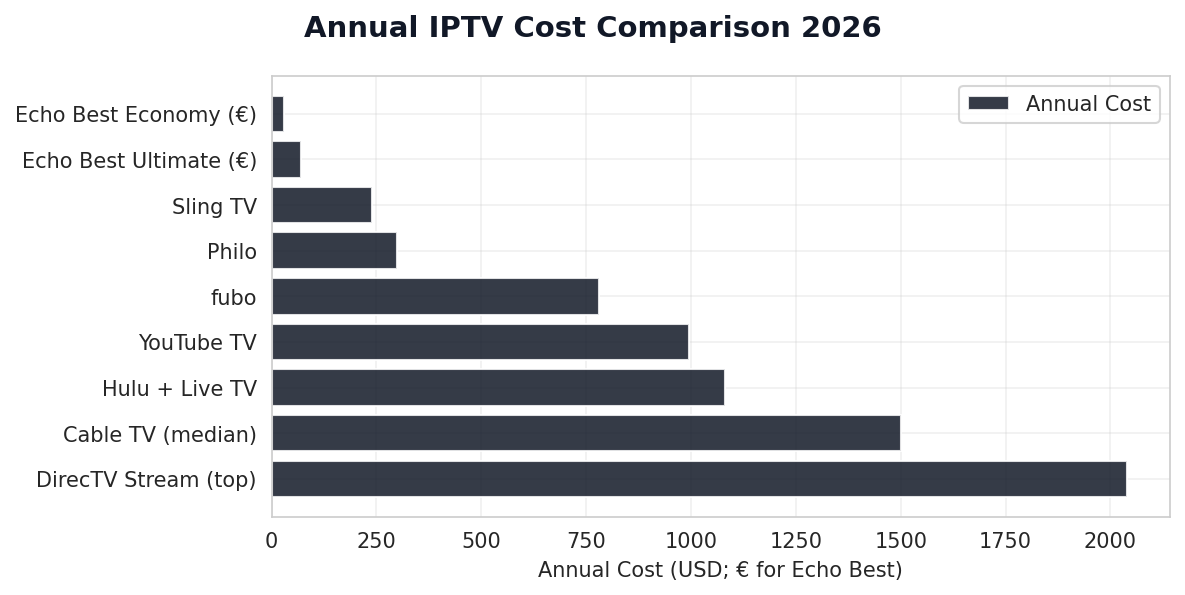
The honest range for licensed US vMVPDs runs roughly $240 to $2,040 per year. Even the cheapest licensed monthly option costs more over 12 months than a top-tier annual plan from a service like Echo Best — which is why the annual model matters, not just the headline price.
If budget is the main driver, keep that comparison in mind and see our breakdown of the cheapest IPTV services and budget plans that actually work in 2026 for a deeper cost analysis.
4K, Catch-Up, EPG, and VOD Features
Four features consistently separate a good IPTV service from a frustrating one. Here is what to look for and what the trade-offs are.
4K streaming requirements
To actually watch 4K you need four things aligned: a 4K source stream on the service, HEVC decoding support in your player app, a 4K-capable device, and a stable connection of roughly 25 Mbps or faster. Any one of those missing and you fall back to 1080p regardless of the plan. Not every channel on a “4K” plan is 4K — the designation usually means some premium channels are available in 4K, not that every stream is.
For a dedicated breakdown of which providers deliver 4K properly, see our 4K IPTV USA guide for 2026.
Catch-up TV
Catch-up gives you a rewind window on live channels — typically 24 hours, 72 hours, or 7 days depending on the plan. It is one of the single most useful features for anyone whose schedule does not line up with the EPG, and one of the first features cut on entry-tier plans. If you often watch things a day or two after they air, confirm catch-up is included before you pay.
EPG quality
A good EPG shows accurate programming 7 days forward, loads instantly, and matches what is actually on the channel. A bad EPG shows yesterday’s listings or no listings at all, which turns channel surfing into a guessing game. Trial periods are when you catch bad EPGs — test one on day one.
VOD libraries
VOD is the on-demand side of the service. Size matters less than freshness and categorization. A 50,000-title library full of forgotten 1990s films is less useful than a smaller library that keeps current-year releases current. Check the top of the “recently added” row during your trial.
Setup and Device Compatibility
Most modern IPTV services run as a regular app on consumer streaming hardware. You do not need a specialist box in 2026, but some choices work better than others.
- Amazon Fire TV Stick. The default US setup. Install the service’s app from the Amazon Appstore if it is listed; if not, you may need to sideload — which is routine but requires enabling “Apps from Unknown Sources” in developer settings. Fire TV Stick 4K Max is the sweet spot for licensed IPTV in 2026.
- Android TV / Google TV. Native Google Play store install, no sideloading needed for licensed services. Good 4K/HEVC support on most 2023+ devices.
- iOS / Apple TV. App Store install only — Apple does not allow sideloading, which rules out some overseas apps but keeps the device safe. Apple TV 4K is excellent hardware for licensed IPTV.
- Smart TV native app. Samsung Tizen, LG webOS, and Vizio SmartCast all carry the major licensed services. Overseas and smaller services often do not have a native TV app — check first.
- Mag box. Dedicated IPTV hardware, popular with services that distribute via STB-style apps rather than mobile apps. Still useful for grandparents and non-technical viewers.
A note on VPNs
Some IPTV services recommend using a VPN, mainly because their streams are geo-restricted or because the ISP throttles video traffic. A VPN does not change the legality of what you are watching — it just encrypts the connection and swaps your apparent location. If you are considering one, our VPN for IPTV guide for 2026 covers when a VPN actually helps and when it adds latency for nothing.
Red Flags to Watch For
The IPTV market is noisy. These signals should slow you down before you hand over a card.
- “Lifetime subscription” offers. No streaming service can honor a lifetime commitment — the carriage deals it depends on do not run that long.
- Only crypto or wire-transfer payment. Legitimate services take cards. Payment method is a licensing proxy.
- No published refund policy. If the terms page is missing or vague, assume you cannot get your money back.
- “20,000+ channels” with no license statement. Licensed vMVPDs count in the dozens or low hundreds. Four-digit channel counts almost always indicate unlicensed aggregation.
- No trial of any kind. Services confident in their product let you watch before you pay.
- Pressure tactics on the checkout page. “Only 2 slots left” countdown timers on an infinite digital product are a red flag everywhere, including here.
- Reused channel art and copy-pasted provider pages. Reseller templates circulate widely; the same screenshots appear across dozens of brands.
For a longer, more technical screen that covers encryption, DNS, and privacy, see our IPTV safety checklist for 2026.
Free vs Paid IPTV
Free IPTV exists, and some of it is genuinely legal. Free Ad-Supported Streaming TV (FAST) services like Pluto TV, Tubi, and the Roku Channel are licensed, carry no subscription cost, and run ads to pay for content. These are a legitimate zero-cost option if you can live with the ad load and a narrower live channel list.
Separately, there are free public M3U playlists that aggregate publicly broadcast internet streams — the IPTV-org open-source project is the best-known example. These are not pirate playlists; they are curated indexes of streams their original broadcasters publish openly. Reliability is uneven and the EPG is thin, but for low-stakes casual watching they work.
Then there are “free trial forever” offers from unlicensed resellers, which are neither free nor sustainable. Those sit on the illegal side of the three-tier framework at the top of this article.
For a safe approach to the legitimate free tier, see our free public IPTV playlist guide for 2026.
What Reddit’s r/IPTV Recommends
The r/IPTV subreddit is one of the most useful public sources on real-world IPTV behavior, and its collective advice is remarkably stable across years.
The community’s rules of thumb:
- Stability beats channel count. A service with 200 channels that never buffers beats a service with 20,000 channels that drops streams every 10 minutes. Buffering during live viewing is the number one complaint and the number one reason users cancel.
- A trial is non-negotiable. The community’s standard answer to “is service X any good?” is “try it on your own hardware for a day.” Any service without a trial is treated with suspicion.
- Reseller churn is a feature of the market, not a bug. Unlicensed services get shut down, rebrand, and resurface regularly. Any recommendation older than six months is treated as stale.
- Payment method matters. The community strongly prefers services that accept cards with chargeback rights over crypto-only options.
For a longer breakdown of what the subreddit currently favors, see our IPTV Reddit recommendations guide for 2026.
A Recommendation Framework: Five Steps
Instead of picking a service from a review, use this five-step process. It will take an afternoon and save you an annual subscription.
- Make a channel list. Write down every channel you actually watched in the last 30 days. If you cannot name five, you probably do not need live TV at all.
- Shortlist 2-3 services that carry those channels and publish their licensing details.
- Start the trial on your real device, not a browser. If the service does not run well on the hardware you actually own, nothing else matters.
- Stress-test during peak hours. 7-10pm local time on a weekday is when streaming infrastructure is under load. Test then, not at noon on a Tuesday.
- Decide by day two. Trials are short. If you cannot find anything to watch in the first day or two, it is not the right fit.
Context for why this works: the US already has 80.7 million cord-cutters as of 2026 according to Leichtman Research data cited by Axis Intelligence. The replacement market is now big enough that no single service can hide a bad experience behind marketing — if you test honestly, you will find out quickly.
FAQ
Is IPTV legal in the USA?
Using a licensed IPTV service is legal. Operating or commercially distributing an unlicensed service is a federal felony under the 2020 Protecting Lawful Streaming Act. Enforcement focuses on operators and large-scale infringers, not individual subscribers, but you have no consumer protection on the unlicensed side.
Can I use IPTV without a VPN?
Yes. A VPN is not required for a licensed IPTV service. Some users add one to encrypt their traffic from their ISP or to work around geo-restrictions on specific apps, but it is not a legality fix — a VPN does not change what you are allowed to watch.
What internet speed do I need for IPTV?
Rough rule of thumb: 10 Mbps for standard-definition, 15-20 Mbps for 1080p HD, and 25 Mbps or more for 4K streaming. These are per-stream numbers — multiply by the number of simultaneous viewers in your household.
How many channels do I actually need?
Fewer than you think. Most households watch fewer than 20 channels regularly. A 60-80 channel vMVPD plan covers more real-world viewing than a 10,000-channel reseller — if the right 20 are in it.
What is the difference between IPTV and streaming services like Netflix?
Netflix and similar SVOD services are on-demand only — you pick from a library whenever you want. IPTV includes live, scheduled channels in addition to any on-demand library. In 2026 the line is blurring, but “live TV included” is still the practical dividing line.
Can I record shows on an IPTV service?
Most licensed vMVPDs include a cloud DVR with hours or unlimited storage. YouTube TV offers unlimited DVR with a 9-month retention window. On the overseas reseller side, cloud DVR is rare — catch-up TV is used instead.
Is 4K IPTV worth it?
Only if your TV and connection support it, and only if a meaningful portion of your watching is in 4K. For news-and-sitcoms viewing the difference is cosmetic. For modern film and premium drama in 4K, the quality jump is real.
What happens if an IPTV provider gets shut down?
On the licensed side, this is a rare, orderly event with refunds. On the unlicensed side, the service disappears overnight, your subscription dies with it, and you have no recourse. Pay with a card that offers chargeback protection if you are evaluating an unknown service.
How do I set up IPTV on a Fire TV Stick?
Install the provider’s app from the Amazon Appstore. If the service distributes outside the Appstore, you will need to enable developer options and sideload the APK — a routine process the provider should document. If a provider cannot explain its own setup in writing, that is a red flag.
Can my family share one IPTV subscription?
Depends on the service. Licensed vMVPDs cap simultaneous streams (typically 3-6) and some restrict to a single household. Smaller services vary widely. Check the stream count on the plan page, not the FAQ.
Final Thoughts
Pick a licensed service, use the trial, test on your real hardware during peak hours, and compare on annual cost — not monthly sticker.
Experience Premium IPTV with Echo Best
Join 50,000+ satisfied customers streaming with Echo Best IPTV
- ✓ Up to 20,000+ live channels depending on plan
- ✓ 50,000+ movies & 70,000+ series in our library
- ✓ 4K content available across all plans
- ✓ 24/7 customer support throughout your subscription
- ✓ 24-hour trial to test before you buy
Get Started with Echo Best IPTV →
Annual plans from €29.90/year | 24-hour trial available
Sources: TROYPOINT September 2026 streaming price roundup; Copyright Alliance analysis of the Protecting Lawful Streaming Act 2020; doxo 2026 US cable bill median; Leichtman Research cord-cutter estimates via Axis Intelligence; provider-published pricing pages verified October 2026.