“Is IPTV legal?” isn’t a yes-or-no question, and any article that answers it with a single word is skipping the part that actually matters. IPTV — Internet Protocol Television — is just a delivery method: television sent over the internet instead of a satellite dish or a coaxial cable. That method is not what makes something legal or illegal. What matters is whether the person distributing the content has the right to distribute it.
This article walks through that distinction, what US copyright law actually says about it, and what it does and doesn’t mean for someone watching a stream.
IPTV the Technology vs. IPTV the Content
IPTV describes how video reaches your screen — as data packets over an internet connection, rather than a broadcast signal. It says nothing about what you’re watching or who has the right to send it to you.
The same is true of a lot of technology. A photocopier is legal; photocopying someone else’s book and selling copies isn’t. The method isn’t the issue — permission is.
So when someone asks “is IPTV legal,” what they usually mean is one of two very different questions:
- Is it legal to deliver television over the internet? (Yes — always has been.)
- Is it legal for a specific service to be streaming the channels it’s streaming? (Depends entirely on whether that service is licensed to carry them.)
Almost every legal question about IPTV is really the second question, not the first.
When IPTV Is Completely Legal
IPTV delivery is the technical backbone of services most Americans already use without a second thought:
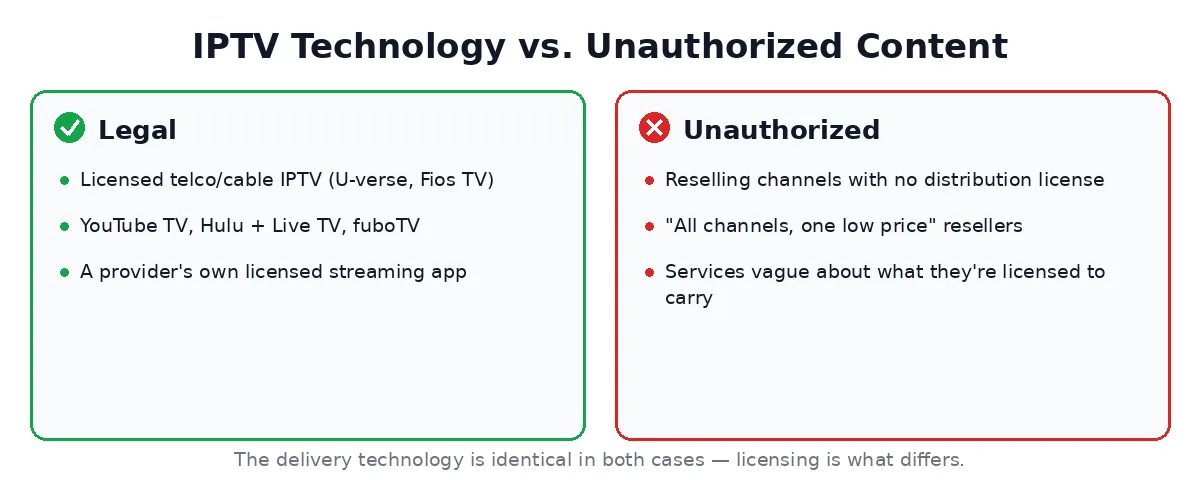
- Telecom-operated TV services delivered over a provider’s own network — services like AT&T U-verse and Verizon Fios TV were built on IPTV technology from the start, not on traditional cable or satellite signals
- Streaming live-TV bundles like YouTube TV, Hulu + Live TV, or fuboTV, which license the channels they carry from the networks and studios that own them
- A cable or satellite provider’s own streaming app, which typically uses the same IP-delivery method behind the scenes
None of these raise legal questions, because the company operating them has negotiated the right to carry that content. The technology is identical to what an unauthorized IPTV reseller uses under the hood — the difference is entirely on the licensing side, not the delivery method.
When IPTV Crosses the Line
US copyright law gives the owner of a work the exclusive right to distribute it. Under 17 U.S.C. § 501, anyone who distributes copyrighted content without the copyright holder’s permission is infringing that right — whether it happens over cable, satellite, or the internet.
In practice, this is what “illegal IPTV” actually refers to: a service is taking channels it has no license to carry (ESPN, premium movie channels, pay-per-view sports, regional sports networks) and reselling access to them. The infringement lives in the unauthorized retransmission, not in the fact that it’s delivered over IP.
This is also the exact distinction the FTC has flagged in its consumer guidance on streaming-related scams — cheap “all channels included” offers with no clear licensing story are a common warning sign, not just a legal one (Source: FTC Consumer Alerts).
Am I at Risk as a Viewer? Civil vs. Criminal Exposure, Explained Carefully
This is the part most articles get vague about, so it’s worth being precise.
Criminal copyright infringement under 17 U.S.C. § 506 applies to someone who “willfully infringes a copyright” for “purposes of commercial advantage or private financial gain,” or who reproduces/distributes copyrighted works over a certain value threshold. Read literally, that provision is aimed squarely at the people operating and profiting from an unauthorized service — the ones doing the distributing — not at someone who bought a subscription to watch a football game. Penalties for that kind of willful, commercial-scale infringement are set out in 18 U.S.C. § 2319.
Civil copyright infringement is broader — under §501, a copyright holder can, in principle, pursue a civil claim against anyone who infringes their distribution right, which is a lower bar than the criminal statute’s “willful” and “commercial advantage” requirements. In practice, individual subscribers to unauthorized IPTV services are a far less common civil-enforcement target than the operators and resellers of those services, since prosecutors and rights holders generally have limited interest and limited practical ability to pursue every individual viewer.
None of that amounts to a guarantee of zero risk, and it isn’t legal advice for your specific situation — copyright enforcement priorities can shift, and the honest answer is that using a service you don’t know to be properly licensed carries some legal and practical uncertainty, even if the realistic risk profile is very different for an operator than for a subscriber.
How to Tell a Legitimate Provider from a Risky One
For a broader look at how premium IPTV services actually work — features, device compatibility, and setup — see our premium IPTV explainer. This section focuses specifically on the legal/legitimacy angle.
Since the legal question comes down to licensing, not technology, the practical question becomes: how do you tell which is which? A few honest signals worth checking before subscribing to any IPTV service:
- Transparency about what’s included. A provider that’s vague about exactly which channels and content are licensed, or that promises “every channel, every sport, every PPV event” for a few dollars a month, is a red flag — that pricing usually isn’t compatible with actually paying for the rights to that content.
- Clear business identity. A real company name, real terms of service, and a way to actually contact support is a baseline, not a guarantee.
- Consistent with FTC scam-pattern warnings. The FTC’s general guidance on streaming and subscription scams is a useful baseline gut-check before handing over payment details (Source: FTC Consumer Alerts).
None of these signals alone proves a service is fully licensed for everything it carries — that information usually isn’t published anywhere a consumer can verify it directly. They’re closer to due-diligence red flags than a certificate of legality.
What If You’re Already Subscribed and Not Sure?
If you already have an IPTV subscription and you’re reading this because you’re suddenly unsure about it, the practical options are the same regardless of what you find:
- Ask the provider directly which specific channels or content packages it’s licensed to carry, and be skeptical of an answer that doesn’t actually name a licensing arrangement.
- Compare the price to what licensing actually costs. A single premium sports package can cost a legitimate broadcaster real money to license — if a provider is offering dozens of premium sports and movie channels for a few dollars a month, that price is a stronger signal than anything on its marketing page.
- Treat “no refunds, pay in crypto only, contact us on Telegram”-style setups as a warning sign, independent of the legal question — those are also the patterns the FTC flags for consumer-protection reasons, not just copyright ones (Source: FTC Consumer Alerts).
Switching providers because you’re uncertain isn’t an admission that you did something wrong — it’s a reasonable response to incomplete information, which is the situation almost every IPTV subscriber is actually in. If you’re evaluating providers from scratch, our guide on how to choose the best IPTV providers covers the broader stability, device, and value questions beyond the legal ones covered here.
Frequently Asked Questions
Does using a VPN with IPTV make it more or less legal?
No — a VPN changes your apparent location and encrypts your traffic; it has no effect on whether the underlying content is licensed. It’s a privacy and network tool, not a legal shield.
Is it illegal to use IPTV outside the US?
This article covers US law specifically. Copyright law varies by country, and a service’s legal status can differ depending on where you are and where the content is licensed.
Can my internet provider tell I’m using IPTV?
Your ISP can generally see that you’re streaming video and roughly how much data you’re using, the same way it can with any streaming service — this article isn’t the place for network-privacy specifics, and it isn’t a substitute for reading a specific provider’s own privacy practices.
If you’re weighing your options and want to see what a transparent provider looks like in practice, take a look at Echo Best IPTV and judge it against the same signals covered above.
This article explains general legal concepts and is not legal advice. If you have a specific legal question about a specific service, consult a qualified attorney.