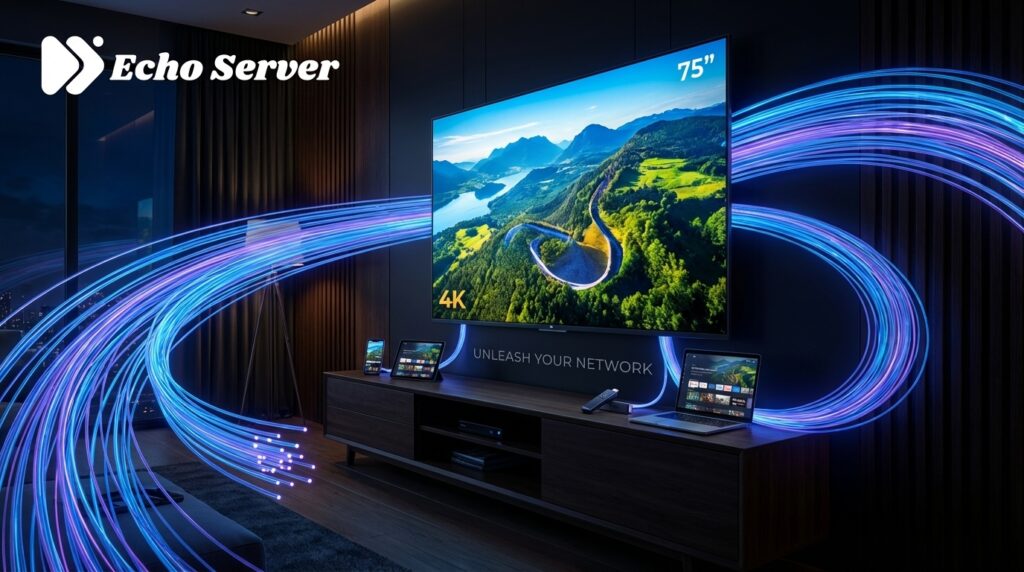
In today’s digital age, the quality of your internet infrastructure can make or break your IPTV streaming experience. Fiber internet is the most popular option for cord cutters who are keen on enjoying seamless high-definition content. It offers the high-speed, reliable connection that is crucial for streaming high-quality video without interruptions.
This is particularly important for those looking to cut the cable cord and transition to IPTV platforms like Firestick, Roku, and smart TVs. Unlike traditional cable or slower alternatives, fiber internet delivers gigabit-level speeds, crucial not only for 4K streaming but also for online gaming and handling multiple devices simultaneously.
As more consumers embrace “Cord Cutting 2.0,” fiber’s dominance showcases its pivotal role in supporting a next-generation streaming lifestyle. This article delves into why fiber infrastructure is key for consistently optimal IPTV streaming quality.
Why Fiber Internet is the Most Popular Option for Cord Cutters
Fiber internet is the most popular option for cord cutters, and the data explains why. A recent Cord Cutters News survey shows fiber accounts for 43 percent of cord cutters’ internet market share, while cable sits close behind at 40 percent. 5G home internet accounts for 14 percent, and satellite services make up the remaining 3 percent. These numbers highlight a clear shift toward next generation wired infrastructure among streaming focused households.
What Drives Fiber’s Lead
- Gigabit level speeds: Fiber delivers consistent gigabit speeds that support 4K streaming, online gaming, and large downloads without buffering or quality drops. This matters when multiple devices stream at once.
- FTTH investments: Providers and municipalities are investing in fiber to the home deployments, improving reliability and lowering latency for end users.
- Consistent performance: Unlike cable, which can slow during peak hours, fiber provides symmetrical upload and download speeds. That results in smoother live streaming and faster content uploads.
- Future proofing: Fiber networks scale easily for higher speeds, so they remain viable as streaming codecs and resolutions advance.
Why Cord Cutters Prefer Fiber for IPTV
- Better 4K and HDR streaming experiences because high sustained bandwidth avoids compression artifacts
- Lower latency for cloud gaming and real time interactions
- Improved performance with many connected devices, from smart TVs to home security cameras
- Less dependence on congested neighborhood nodes compared to shared cable networks
Context from Cord Cutters News
Cord Cutters News frames this change as part of “Cord Cutting 2.0,” where consumers not only ditch pay TV but also pick internet services optimized for streaming. The survey and analysis by Luke Bouma trace how cable providers lost share due to rising costs and slower upgrade cycles, while fiber adoption climbed as households prioritized speed and reliability source. For more background and the full survey details see the Cord Cutters News coverage source.
Key Takeaway
For IPTV users, choosing fiber often means fewer interruptions, better picture quality, and a network that scales with future streaming demands. Therefore fiber remains the top choice for cord cutters who want a premium streaming experience.
Market Share and Benefits for Cord Cutters
Therefore the table shows why fiber leads in streaming quality and reliability.
| Provider | Market Share (percent) | Key Advantages | Typical Use Case |
|---|---|---|---|
| Fiber | 43% | Gigabit speeds, low latency, symmetrical upload/download, highly reliable | 4K HDR streaming, online gaming, heavy multitasking, smart homes |
| Cable | 40% | Wide availability, established infrastructure, competitive pricing | HD streaming, casual gaming, households with moderate device counts |
| 5G Home | 14% | Easy setup, wireless flexibility, improving speeds | Temporary setups, areas lacking wired infrastructure, mobile households |
| Satellite | 3% | Coverage in remote locations, wide geographic reach | Rural connectivity, basic streaming, backup internet service |
Technology and Service Advantages of Fiber for IPTV Users
Fiber internet delivers a clear technical edge for IPTV streaming. It provides consistent throughput, low latency, and near symmetric upload and download speeds. According to Cord Cutters News, fiber accounts for 43 percent of cord cutters’ market share, underscoring why many streamers choose fiber for Firestick, Roku, and smart TV setups.
Core technology advantages
- Gigabit speeds: Fiber supports gigabit and multi-gigabit plans, enabling smooth 4K HDR streaming and fast content downloads. Because bandwidth is abundant, streams rarely rebuffer.
- Low latency: Fiber reduces round trip times, which improves live streaming and cloud gaming responsiveness. Therefore gamers and streamers notice fewer lags.
- Symmetrical performance: Upload speeds often match downloads on FTTH connections, so live broadcasts and video calls stay high quality.
- Reliability: Fiber resists electrical interference and weather issues that affect copper and satellite links, so uptime improves.
- Scalability with FTTH: Fiber to the home investments let providers increase capacity without rewiring neighborhoods later.
Competitors and user experience
Cable providers like Comcast and Spectrum still serve many households. However cable networks often share bandwidth among neighbors. As a result peak hour congestion can cause bitrate drops and pixelation on IPTV streams. By contrast, fiber delivers more consistent streaming quality across multiple devices.
How fiber directly improves IPTV streaming
- Better 4K and HDR playback because sustained bandwidth keeps encoder bitrates high.
- Fewer buffering events even when several devices stream at once.
- Smoother live TV and sports streams due to stable throughput.
- Improved cloud gaming and interactive apps because latency stays low.
Implementation and practical benefits
Because providers continue FTTH rollouts, more homes will gain access to fiber. For cord cutters, this translates into fewer interruptions, clearer picture quality, and headroom for future codecs and higher resolutions. Therefore investing in fiber often means a better, longer lasting streaming experience for IPTV users.
CONCLUSION
Fiber internet matters for cord cutters and IPTV users more than ever. It delivers gigabit speeds, low latency, and consistent performance for 4K streaming. Because fiber supports FTTH and symmetrical connections, it handles many devices without buffering. Cord Cutters News shows fiber leads the market, and therefore consumers prioritize speed.
Echo Server IPTV provides reliable streaming for live TV, movies, series, and sports. The company partners with more than 25 trusted providers to widen content choices. Serving over 20,000 customers, Echo Server IPTV focuses on uptime and playback quality. As a result, viewers experience fewer interruptions and clearer picture quality.
Echo Server IPTV also emphasizes support and customer satisfaction through responsive service. Therefore, for cord cutters, that commitment pairs well with fiber networks for best streaming results. In short, choosing fiber reduces buffering and improves image fidelity for IPTV viewers. Therefore, pair a fiber plan with a trusted IPTV provider like Echo Server IPTV for optimal results.
Frequently Asked Questions (FAQs)
Why is fiber internet preferred for IPTV streaming?
Fiber delivers consistent gigabit speeds and low latency, so streams stay smooth. Because fiber provides symmetrical upload and download rates, live broadcasts and video calls look better. In addition, fiber resists electrical interference, which improves uptime and reliability. Therefore IPTV users get higher sustained bitrates and fewer buffering events.
How does fiber compare with cable, 5G home, and satellite?
– Fiber: 43 percent market share among cord cutters, according to Cord Cutters News. It offers gigabit speed, low latency, and FTTH scalability for future codecs.
– Cable: 40 percent market share. It provides wide availability, but networks can congest during peak hours. As a result, streaming quality can drop.
– 5G home: 14 percent market share. It is flexible and quick to set up; however, performance varies by signal and location.
– Satellite: 3 percent market share. It reaches rural areas, but latency and data caps limit high-quality streaming.
For source details see Cord Cutters News: Cord Cutters News.
Will switching to fiber eliminate buffering and improve 4K performance?
Switching to fiber significantly reduces buffering risk because of higher sustained throughput. However, performance also depends on your home router, local network, and the IPTV server. Therefore, check router capability and network settings as well. In practice, fiber plus a modern router gives the best chance of flawless 4K HDR streaming.
Is fiber worth the cost and installation time?
Many users find fiber worth it because it offers longevity and headroom for future needs. Installation may take longer than a simple wireless setup, but FTTH investments pay off over time. If you stream 4K, game online, or run many devices, fiber often reduces long-term costs related to service problems.
Can I still use IPTV with cable or 5G if fiber is unavailable?
Yes. Cable and 5G work well for many viewers. However, expect more variability during peak hours with cable and more signal dependence with 5G. Therefore, evaluate peak hour speeds, latency, and data caps before choosing.